

What kind of display rack can showcase shirt
By Shenzhen Topwon Group Co.,Ltd
Apr 26, 2024
Choosing a cardboard shirt display stand starts with how your shirts are packed, how many you need to display, and where shoppers will find them. A design for folded shirts may not suit gift boxes, while a compact countertop display serves a different purpose from a floor-standing unit.How to Choose a Cardboard Shirt Display Stand?
The goal is not simply to fit more products into a display. It is to keep sizes and styles organized, make products easy to remove, and give store staff a practical way to replenish stock.
TopWon’s cardboard shirt display range includes floor-standing shirt displays, polo shirt displays, and clothing pallet displays. These provide starting points for a custom project, with the final layout developed around the products and retail requirements.

This guide explains how to compare the options, review a sample, and prepare a useful brief for your supplier.
1. Match the Display Layout to Your Shirt Packaging
Before choosing the display’s shape, confirm how the shirts will be presented to shoppers.
Folded, Unwrapped Shirts
For folded shirts, consider shelves or divided compartments that separate styles, colors, and sizes.
Review the layout using the actual retail fold. Check that:
Each stack fits without being compressed.
Shoppers can remove a shirt without disturbing neighboring stacks.
Size information remains visible.
Staff can straighten and replenish the products easily.
Provide the folded dimensions rather than the garment’s unfolded measurements. If different sizes create noticeably different pack dimensions, include those variations in the brief.
Individually Bagged Shirts
For bagged shirts, measure the complete retail pack, including any header, folded edge, or extra packaging.
Decide whether the packs will stand upright, lean within a compartment, or lie flat. The arrangement should keep the product and size information visible.
During sample review, load the intended quantity and check what happens when customers remove several packs. A layout should work with partially depleted stock, not only when fully loaded.
Boxed Shirts and Gift Sets
For boxed shirts, base the structure on the box dimensions, unit weight, and planned quantity.
Shelves, trays, or individual compartments may be considered, depending on the packaging. Leave enough access space for customers to remove a box without lifting adjacent products.
| Shirt format | Layout to consider | Main point to review |
|---|---|---|
| Folded shirts | Shelves or divided compartments | Stack organization and access |
| Bagged shirts | Trays, shelves, or compartments | Pack orientation and label visibility |
| Boxed shirts | Product-sized trays or shelves | Fit, loading, and removal space |
| Hanging shirts | A separately assessed hanging structure | Support, clearance, and stability |
Use these as design starting points. Confirm the final arrangement with actual products in a sample.
2. Choose the Right Display Position
Once the product arrangement is clear, decide where the display will sit.
Floor-Standing Shirt Displays
A floor-standing unit is a useful option to review when you need a dedicated presentation area or several product sections.
Before developing the structure, confirm:
The available floor footprint.
The permitted display height.
The number of styles, colors, and sizes.
The quantity required in each section.
The space needed for browsing and replenishment.
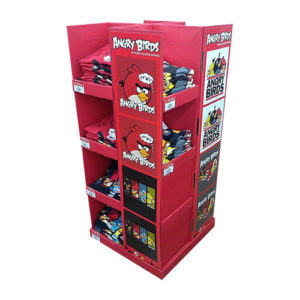
TopWon’s Shirt Cardboard Floor Display SCD13683 provides a product reference for this format. Its page lists customized dimensions and printing, along with packing options that can be reviewed for the order.
Countertop Shirt Displays
A countertop unit may be considered for a compact selection of packaged shirts, subject to the available space and loaded weight.
Measure the usable counter area before selecting a layout. Check that the products do not obscure the display header or interfere with the counter’s main function.
Do not assume that a small display designed for clothing accessories will also fit shirts. The actual retail pack should determine the required compartment size.
Published Size References
TopWon’s T-shirt retail display case study includes the following planning references. These are examples published on the site, not fixed specifications for every order.
| Display format | Example dimensions: width × depth × height | Listed placement |
|---|---|---|
| Countertop | 30–40 × 20–25 × 40–50 cm | Checkout counters and dedicated counters |
| Narrow floor-standing | 40–50 × 30–35 × 150 cm | Aisles, corners, and smaller stores |
| Wide floor-standing | 60 × 40 × 160 cm | Main aisles and promotional areas |
| Wide floor-standing | 120 × 60 × 120 cm | Larger promotional areas |
The correct size still depends on the product dimensions, stock plan, store restrictions, and proposed structure.
3. Plan Capacity by Style, Color, and Size
“Hold 30 shirts” is not a complete design brief.
A display for one style in several sizes needs a different arrangement from a display for multiple styles and colors. Prepare the stock plan before deciding how many shelves or compartments to use.
Specify:
The number of shirt styles.
The colors included.
The sizes that need separate positions.
The quantity per size or section.
The expected replenishment routine.
For example, a single-style promotion may use repeated compartments for sizes. A mixed collection may first need separate areas for styles, with size divisions inside each area.
TopWon’s fashion apparel display project describes a design with an overall height of 42 inches and compartment depths of 8.5 inches and 4.5 inches. The project illustrates how different storage sections can be incorporated into one apparel display.
These are project-specific dimensions, not universal recommendations. Their value is in showing why the compartment layout should follow the products rather than the other way around.
4. Compare Relevant Shirt Display Products
Use existing products to communicate the format you have in mind, then confirm what must change for your order.
| TopWon product | Starting point for discussion | What to confirm |
|---|---|---|
| Shirt Cardboard Floor Display — SCD13683 | A floor-standing shirt display | Product fit, layout, dimensions, graphics, and packing |
| Cardboard Polo Shirt Display — SCD16123 | A polo shirt display project | Retail fold, size separation, quantity, and customized structure |
| Cardboard Retail T-Shirt Display — SCD16119 | A T-shirt retail display project | Pack dimensions, stock arrangement, printing, and delivery format |
The product pages list customization options, but they do not establish one capacity or load rating for every configuration. Confirm those requirements for the proposed design rather than estimating them from the product name or photograph.
5. Review Shipping, Assembly, and Portability
A display needs to work for the people receiving and installing it, not only for shoppers.
TopWon’s SCD13683 and SCD16119 product pages list different packing arrangements, including flat-packed and assembled options. Discuss which arrangement applies to your project before approving the order.
Ask:
Will the display arrive flat-packed or assembled?
Who will assemble it at the store?
Are separate components or fittings required?
Will shirts be loaded before or after delivery?
Will the display need to be moved during the promotion?
If repeated dismantling or relocation is required, state that at the beginning. A structure intended for one installation should not automatically be assumed suitable for repeated handling.
Review the assembly method with a physical sample or demonstration before a multi-store rollout.
6. Add Modular or Creative Features Only When Needed
Modular sections can be considered when the stock arrangement changes between stores or campaigns.
Define what needs to change:
Dividers.
Product sections.
Promotional headers.
Graphic panels.
Pack sizes.
If the product range is unlikely to change, a simpler fixed layout may be more appropriate than additional interchangeable components.
Creative features also need a practical purpose. A shaped header or distinctive graphic treatment may communicate the campaign without adding a complex mechanism.
For wall-mounted, rotating, or hanging formats, request a separate structural review covering the mounting or support method, loaded arrangement, access, and stability. Do not assume these features are suitable simply because they appear in a display reference image.
7. Design Graphics Around the Loaded Display
Branding should help shoppers understand the offer without making the display harder to use.
Prioritize:
A recognizable brand or campaign header.
Clear product identification.
Readable size and style labels.
Promotional information that products will not cover.
Review the artwork with shirts in place. Important information should remain visible when the display is full and understandable as stock sells down.
TopWon’s services include display design, printing, manufacturing, and packing, allowing buyers to discuss the graphic and structural requirements together during project planning.
Provide the latest artwork version, logo files, and important brand-color references. If color matching is critical, clarify the approval reference and sampling requirements before production.
8. Use Sample Approval to Resolve Practical Questions
A rendering can communicate the concept, but a sample helps check product fit and handling.
Load the intended shirts and review:
Do the products fit in the planned arrangement?
Can shoppers remove one item easily?
Do neighboring products remain organized?
Are labels and graphics visible?
Can staff replenish stock conveniently?
Is assembly clear?
Is the loaded structure suitable for the agreed use?
Record whether approval covers structure, artwork placement, printed appearance, or the complete finished sample.
TopWon’s floor display page describes a workflow covering samples, mass production, and delivery. Use the sampling stage to resolve the project’s product-fit and handling requirements before bulk production.topwongroup
A T-Shirt Retail Project: From Design to Sample Approval
In a published TopWon case study, a U.S. T-shirt retailer wanted promotional displays that could support updated campaign graphics. Before ordering, the customer raised questions about capacity, customization costs, order quantity, and whether the finished display would match the design.
The project moved through design development and physical sampling before the displays were used in stores. The case also records a subsequent order for additional styles.
The practical lesson is to discuss capacity, appearance, and sample approval together. A display should not be approved for its graphics while its product arrangement remains unresolved.
What to Send for a Custom Shirt Display Quote
Prepare the following information before requesting a proposal:
| Information | What to provide |
|---|---|
| Product format | Folded, bagged, boxed, or hanging |
| Product dimensions | Actual retail-ready measurements |
| Product weight | Weight per unit, including packaging |
| Stock plan | Styles, colors, sizes, and units per section |
| Display position | Floor, counter, or another proposed location |
| Space limits | Maximum width, depth, and height |
| Use requirements | Campaign duration and any relocation needs |
| Shipping preference | Flat-packed, assembled, or another arrangement to review |
| Branding | Artwork, logo, and important color references |
| Order quantity | Estimated number of displays |
| Sample approval | What needs to be checked before production |
Find a Cardboard Shirt Display Stand for Your Project
Start with TopWon’s cardboard shirt display range to review relevant formats. For project examples, explore the clothing, hats, and shoes display case studies.
Send your product photos, retail-ready dimensions, unit weight, planned capacity, and available display space. Include any reference images and branding requirements so the proposed structure can be reviewed alongside its printed appearance.
Before production, confirm the dimensions, product arrangement, packing method, and sample approval requirements for your order.



Previous Article
How to better utilize cardboard display for showcasing shirts more effectively


Next Article
What kind of cardboard display stand is suitable for displaying lipsticks
Trusted by These Featured Clients